
Table of Contents
- The Four Main Hair Types
- Understanding Hair Texture, Density and Strand Thickness
- How to Find Your Hair Type at Home
- Using a Hair Type Chart to Identify Your Pattern
- Wavy Hair Types 2A, 2B, and 2C: What Sets Them Apart
- Choosing Products for Different Hair Types
- Styling Techniques That Work for Your Hair Type
- Common Hair Type Misconceptions
- Frequently Asked Questions
Last Updated: October 7, 2026
The Four Main Hair Types
Understanding your hair types is the foundation for choosing the right products and styling approach. Hair falls into four primary categories based on natural texture and curl pattern, each responding differently to products, heat, and styling.
The system ranges from straight to coily, with variations within each category.
Type 1: Straight Hair
Straight hair has no natural curl or wave pattern. It lies flat against the scalp and reflects light easily, which is why it often appears shiny.
Straight hair can be fine or thick, and this matters for product selection. Fine straight hair looks limp without volumising products, while thick straight hair is strong but can appear heavy or lack movement.
Common concerns with straight hair include:
- Flatness at the roots
- Greasiness, as natural oils travel easily down the hair shaft
- Difficulty holding curls or waves
- Lack of texture and dimension
Type 2: Wavy Hair
Wavy hair has a gentle S-shaped pattern between straight and curly, creating natural texture and movement without defined curls. It's versatile, styling sleek or textured depending on your preference.
Wavy hair responds well to products that enhance its pattern without weighing it down, but waves can be unpredictable, defined one day, barely visible the next. This happens because wavy hair is more sensitive to humidity, product layering, and styling technique than straighter textures.
Type 3: Curly Hair
Curly hair has a distinct spiral or corkscrew pattern, forming because the strand grows in a curved shape rather than straight. This creates natural volume and texture, but curly hair requires specific care to keep curls defined and healthy.
Curly hair tends to be drier than straighter types because natural oils struggle to travel down the twisted shaft, leading to frizz and breakage without proper moisture. It also benefits from products with hold and definition.
Type 4: Coily Hair
Coily hair, sometimes called kinky or textured hair, has very tight, compact curls that form close to the scalp, creating significant volume and density. It has the most distinct curl pattern and requires tailored care.
Coily hair is the driest of all hair types because oils have the furthest to travel down the shaft, and it's the most fragile. Gentle handling and moisture-rich products that define curls, reduce frizz, and provide deep hydration are essential.
Understanding Hair Texture, Density and Strand Thickness
Beyond the four main hair types, three factors shape how your hair behaves: texture, density, and strand thickness. These work alongside your hair type to determine which products and techniques suit you best.
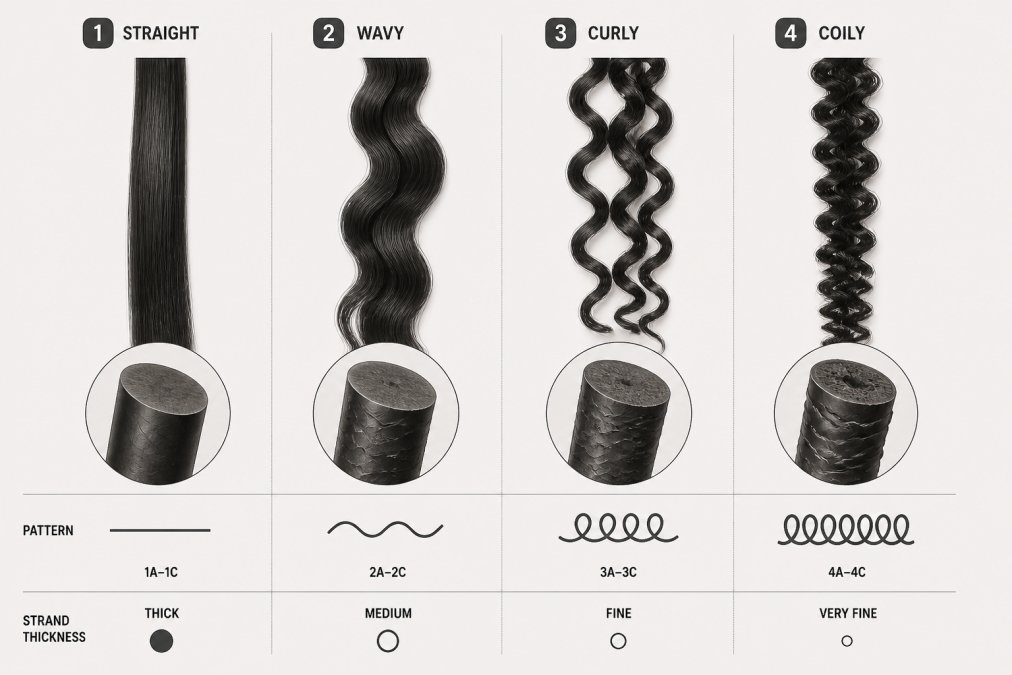
Hair texture refers to the surface feel of your hair. Rough texture often indicates a raised cuticle, which can trap moisture but also cause frizz. Smooth texture means the cuticle lies flat, creating shine.
Hair density describes how many strands you have on your scalp. High density means more strands packed together, creating fullness; low density means fewer strands, which can look thinner even if each strand is thick.
Strand thickness (hair diameter) is the width of each individual strand. Fine strands are delicate and break easily under tension; thick strands are stronger but harder to style and need more product for hold.
These factors work together: someone with coily hair, rough texture, low density, and fine strands needs very different care than someone with wavy hair, smooth texture, high density, and thick strands.
How to Find Your Hair Type at Home
Identifying your hair type doesn't require a salon visit, a simple at-home test works. The key is observing your hair in its natural state without styling products or heat.
Wash with a gentle cleanser and let your hair air dry completely, avoiding heat tools or styling products that alter the natural pattern.
Once your hair is fully dry, look at individual strands. Do they lie completely flat? Do they have a slight wave? Do they curl into rings? Do they coil tightly? Compare what you see to the four main categories.
Check multiple areas of your scalp, as hair type can vary from crown to sides to nape. Many people have a combination type, straighter on top, wavier underneath, which is completely normal.
Pay attention to how your hair behaves in different conditions:
- How does it look on humid days?
- Does it hold a curl when you style it?
- How quickly does it get greasy?
- Does it frizz easily?
These observations reveal not just your type but your hair's individual needs. One person with type 2 wavy hair might struggle with frizz in humidity, while another finds their waves disappear in moisture.
Using a Hair Type Chart to Identify Your Pattern
A hair type chart provides a visual reference for comparing your hair to standard categories. The most common system uses numbers 1-4 for the main types, with letters A-C indicating variation within each.
Type 1 is straight with no curve. Type 2 is wavy, ranging from loose waves (2A) to more defined waves (2C). Type 3 is curly, from loose curls (3A) to tight curls (3C). Type 4 is coily, from loose coils (4A) to very tight coils (4C).
When using a chart, compare your curl pattern and tightness to the images, looking at overall shape. Charts are guides, not absolute rules, your hair might sit between two categories, and that's perfectly valid.
The limitation of charts is that they show curl pattern only, not texture, density, or strand thickness. Identifying your hair type requires looking beyond visual comparison to how your hair feels and behaves.
Wavy Hair Types 2A, 2B, and 2C: What Sets Them Apart
Wavy hair divides into three subcategories based on wave definition. Understanding these distinctions helps you choose products and techniques that enhance your specific pattern.
Type 2A has the loosest waves, subtle and often invisible until air dried, it looks straight when wet and develops waves as it dries. It's the finest wavy subcategory and can look limp without volumising products.
Type 2B has more defined waves than 2A but less than 2C, with a visible, consistent S-shape. It holds waves well and responds to texture-enhancing products that don't weigh it down.
Type 2C has the tightest waves, almost approaching loose curls, with a very visible, consistent pattern. It has more volume than 2A or 2B and handles heavier products without looking weighed down.
The main difference between these three is how tightly the wave forms. This affects which products work best and how much styling effort is needed to enhance your natural pattern. Type 2A might need volumising products and wave-enhancing techniques, while Type 2C might need moisture and definition products.
Choosing Products for Different Hair Types
Product selection should match both your hair type and your individual characteristics like texture and density. The wrong products can make your hair look worse, not better.
For straight hair, focus on volumising and texturising products. Our Liquid Gold Nourishing Oil works beautifully on straight hair as a finishing touch, just one or two pumps through the ends adds shine without the greasy appearance that heavier oils create.

For wavy hair, choose products that enhance your wave pattern without disrupting it. Lightweight creams, gels, and serums that define waves are ideal. Avoid heavy butters or oils that will weigh waves down and make them disappear.
For curly hair, prioritise moisture and definition. Curly hair needs hydrating products that keep curls bouncy and defined. Look for creams, gels, and leave-in conditioners designed specifically for curls. These products help lock moisture into the hair shaft and reduce frizz.
For coily hair, moisture is critical. Deep conditioning treatments, hydrating leave-in conditioners, and nourishing oils are essential. Coily hair needs products that penetrate deeply and provide lasting hydration. Lightweight products won't provide the moisture level this hair type requires.
Product type matters as much as product formulation:
- Shampoos should cleanse without stripping natural oils
- Conditioners should match your moisture needs
- Styling products should enhance your natural pattern
- Oils and serums should add shine without weighing hair down
Styling Techniques That Work for Your Hair Type
How you style your hair matters as much as what products you use. Different hair types respond to different techniques.
Straight hair benefits from techniques that add texture and movement. Blow drying with a round brush creates volume at the roots. Curling tools or braiding techniques add temporary waves or curls.
Wavy hair thrives when you enhance the natural wave pattern. Scrunching products into damp hair encourages waves to form. Air drying or diffusing with a blow dryer helps waves set without disrupting them. Avoid brushing waves when they're dry, as this breaks up the pattern and creates frizz.
Curly hair needs techniques that define and protect curls. The "praying hands" method, applying products by smoothing them down the hair shaft between your palms, helps define curls without disrupting them.
Coily hair requires the gentlest techniques. Finger detangling (separating tangles with your fingers rather than a comb) is gentler than any tool. Applying products to soaking wet hair and using the praying hands method helps coils form and stay defined.
Heat styling affects all hair types differently:
- Straight hair can handle heat well but doesn't need it
- Wavy hair benefits from gentle heat to encourage wave formation
- Curly hair can be damaged by excessive heat
- Coily hair is most vulnerable to heat damage
Common Hair Type Misconceptions
Several myths about hair types lead people to make poor product and styling choices. Understanding what's actually true helps you care for your hair more effectively.
Myth: Straight hair doesn't need special care. Straight hair has its own challenges.
Myth: All curly hair is the same. Curly hair ranges from loose 3A curls to tight 3C coils. Each variation needs different products and techniques.
Myth: You can change your hair type with the right products. Your hair type is determined by genetics. Products can't change whether your hair is straight, wavy, curly, or coily.
Myth: Thicker hair is always better. Thick hair has advantages and disadvantages.
Myth: Hair type stays the same forever. Hair can change over time due to hormones, age, health, and damage.
Myth: You need expensive products to care for your hair properly. Price doesn't determine effectiveness. At Ellan Hair, we focus on professional-grade formulations and honest materials that actually work.
Finding your hair type is the first step toward a hair-care routine that actually works.
Frequently Asked Questions
How do I find out what my hair type is?
Start with clean, air-dried hair free of products. Examine a single strand from the crown or back section. Look at its natural shape: does it fall straight, form gentle waves, create defined curls, or coil tightly? Compare your pattern against a hair type chart. You can also perform the strand test by holding a section under tension, straight hair remains flat, wavy hair shows S-shaped bends, curly hair forms loops, and coily hair springs back when released. Most people have a mix of types across their scalp, so check multiple sections.
What's the difference between hair type and hair texture?
Hair type refers to your curl pattern or shape: straight, wavy, curly, or coily. Hair texture describes the thickness of individual strands, fine, medium, or thick. You can have fine, straight hair or thick, coily hair; these are separate characteristics. Texture affects how hair holds moisture, responds to heat, and tolerates styling. Understanding both helps you select products and techniques suited to your specific needs rather than just your curl pattern alone.
Can your hair type change over time?
Yes, hair type can shift due to hormonal changes, age, health conditions, or damage. Pregnancy, menopause, and medication can alter curl patterns. Chemical treatments, heat styling, and colour processing damage hair and may change its appearance. Severe damage can make curly hair appear straighter temporarily. However, your natural hair type, determined by your hair follicles, remains the same. If your hair feels different, it may be damaged rather than naturally changed, which is why proper care and professional-grade products are important for maintaining your hair's true texture and health.
How do I choose hair products for my hair type?
Match products to both your curl pattern and texture needs. Straight and fine hair benefits from lightweight oils and volumising products that won't weigh it down. Wavy hair needs definition and frizz control without heaviness. Curly and coily hair requires moisture-rich products that define curls and reduce frizz. Consider porosity, how well your hair absorbs and retains moisture, when selecting serums and oils. Products like Liquid Gold Nourishing Oil work across multiple hair types because they provide softness and shine without greasiness. Always test on a small section first, and prioritise professional-grade formulas designed for your specific needs.